
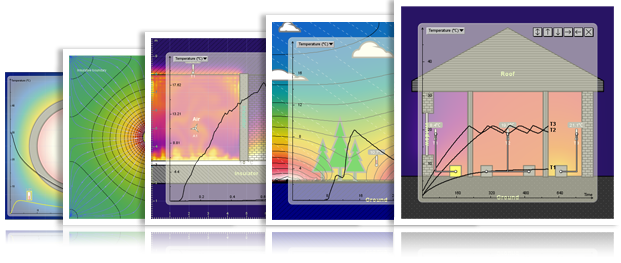
“Please accept our thanks and congratulations for your very interesting work which I am sure are having a great positive impact in our society.” — from Roberto Quevedo, Instituto Volcanológico de Canarias, INVOLCAN, Puerto de la Cruz, Tenerife, Canary Islands, Spain
By Carmen Trudell, University of Virginia
What is it?
Based on computational physics, Energy2D is an interactive multiphysics simulation program that models all three modes of heat transfer—conduction, convection, and radiation, and their coupling with particle dynamics. Energy2D runs quickly on most computers and eliminates the switches among preprocessors, solvers, and postprocessors typically needed to perform computational fluid dynamics simulations. It allows you to design "computational experiments" to test a scientific hypothesis or solve an engineering problem without resorting to complex mathematics. Work is also underway to incorporate other types of energy transformations (e.g., phase changes and chemical reactions through the Stefan condition) and support multiple types of fluids (e.g., air and water).
How to cite it?
Charles Xie, Interactive Heat Transfer Simulations for Everyone, The Physics Teacher, Volume 50, Issue 4, pp. 237-240, 2012.
| 
|
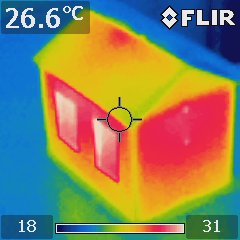
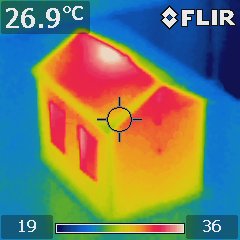
| An IR image of a heated model house with a ceiling | An IR image of a heated model house without a ceiling |
| 
|
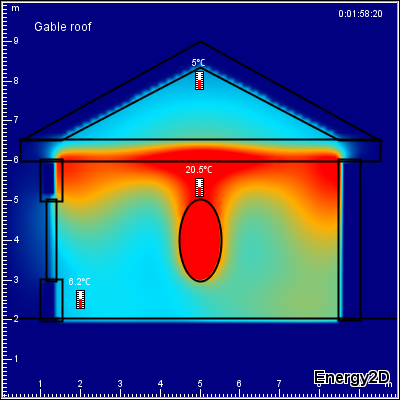
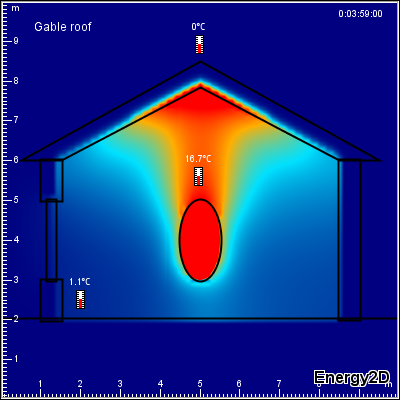
| An Energy2D simulation of a heated house with a ceiling | An Energy2D simulation of a heated house without a ceiling |
How well does it model reality?
The conduction part of Energy2D is highly accurate, but the convection and radiation parts are not 100% accurate. Hence, in cases that involve convection and radiation, Energy2D results should be considered as qualitative. The pictures to the right show a comparison of the results of Energy2D simulations with images from infrared thermography for a simple model house. The thermal patterns predicted by Energy2D roughly match those from a thermal camera.
How many papers have used it?
More than 40 scientific papers have used Energy2D as a research tool (not just a citation), demonstrating its wide applications across science and engineering.
How many books have recommended it?
The following is a list of books that have recommended Energy2D:
- Franco Landriscina, Simulation and Learning: A Model-Centered Approach, Springer, 2013
- Jiyuan Tu, Guan Heng Yeoh, and Chaoqun Liu, Computational Fluid Dynamics, Second Edition: A Practical Approach, Butterworth-Heinemann, 2012
What people are saying about it?
“...we have suggested the adoption of the platform Energy2D for a very effective “what-if” game in terms of the construction of cases of study eventually much more complex than the one here addressed. We have shown a solid reliability of the simulation in the description of our experiment: it can open the way to a basically unlimited number of applications, including those, for example, in which convective transport phenomena play a non-negligible role.” — from Stefano Oss, European Journal of Physics
“The software program Energy2D is used to solve the dynamic Fourier heat transfer equations for the Convective Concrete case. Energy2D is a relatively new program (Xie, 2012) and is not yet widely used as a building performance simulation tool. To gain more confidence in the predictions with Energy2D, an analytical validation study was therefore carried out first, inspired by the approach described in Hensen and Nakhi (1994). Those analytical solutions and the simulation results of the dynamic response to a 20°C temperature step change on the surface of a concrete construction with the following properties were compared for this research... the simulation results never divert from the exact solution more than 0.45°C and it is therefore considered acceptable to further use this model.” — Dennis de Witte, Marie L. de Klijn-Chevalerias, Roel C.G.M. Loonen, Jan L.M. Hensen, Ulrich Knaack, & Gregor Zimmermann, Journal of Facade Design and Engineering
“Thank you for your absolutely great app which helps me a lot for visualizing my lecture in thermodynamics. It is also very nice to see that three platforms are supported and every single one is free to use. That is just awesome and I want to say thank you for all users. I do not know how many messages of this type you are receiving.” — from Martin Weise, Austria
“In gearing up to teach a course called Building Science this semester, I somehow stumbled across your program Energy2D and Energy3D. I was really impressed by how simple and easy these tools were and I'm definitely going to integrate them into some portion of my lectures.”— Prof. Brent Stephens, Department of Civil, Architectural and Environmental Engineering, Illinois Institute of Technology, USA
“I am currently involved in renewable energy related research activities and teaching. I have downloaded and demonstrating Energy2D for my heat transfer course. It is really a very useful tool.”— Dr. Mazharul Islam, Department of Mechanical Engineering, Taibah University, Saudi Arabia
“Today during the lunch break a little simulated comparison fan in the suction and blowing operation collector here about 50x70 cm and fan with 2 meters / second. [The result] is confirmed by the experiences of several users: pressure losses and less volume of air in the blowing operation.” (Link to the source)
“...what was really interesting, was that when I continued playing with the simulator, sometimes my convection examples would split into two cycling air cells, one above and to the left, one below and to the right, with the hot air blasting right for the cold source, rather than rising. That's really interesting, because I've experienced this when using smoke demonstrations in class, and the fact that the simulator can capture that behavior shows how accurate this teaching tool actually is.” (Link to the source)
“...this free software is basic, yet you can modify properties and all, the desktop download gives better results and the pages have a choice of practical setups to download and use that are very practical” (Link to the source)
